
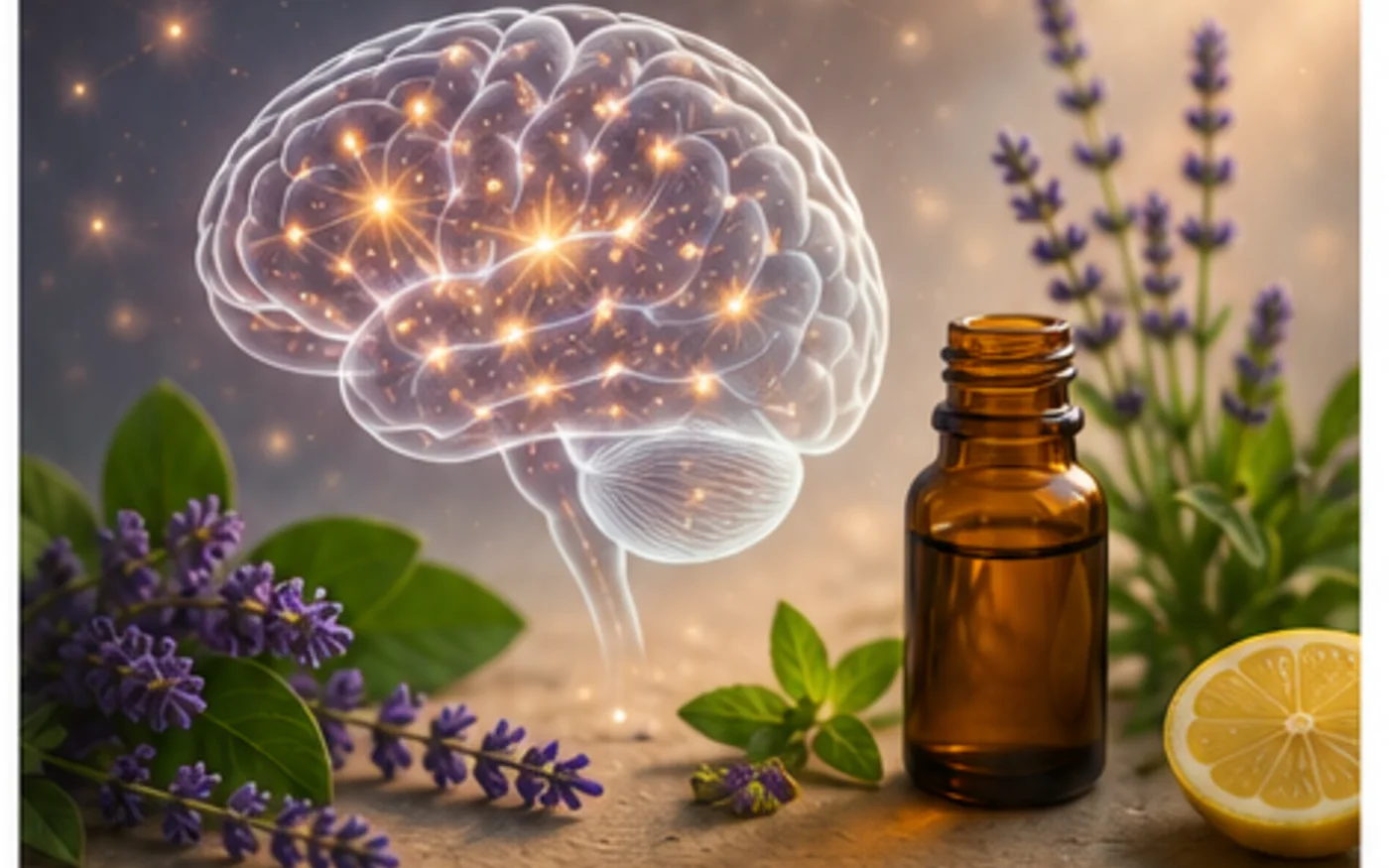
Neurodegenerative diseases — including Alzheimer’s disease, Parkinson’s disease and age-related cognitive decline — are major health concerns. Alongside conventional medicine, researchers have investigated whether essential oils and individual aroma compounds may influence oxidative stress, inflammation, neurotransmitter activity and neuronal survival.
Essential oils are complex mixtures of plant-derived volatile compounds. Laboratory studies have reported antioxidant, anti-inflammatory, anti-apoptotic and acetylcholinesterase-inhibitory activity for selected constituents. These findings are scientifically interesting, but they do not establish essential oils as treatments for dementia or any other neurological disease.
How essential oils and aroma compounds may support brain-health research
1. Antioxidant activity
Oxidative stress contributes to neuronal injury and age-related cognitive decline. Several essential-oil constituents can neutralise reactive species in laboratory systems and may help reduce oxidative damage to nerve cells. Antioxidant activity measured in a test tube, however, does not automatically predict a clinical effect in humans.
2. Anti-inflammatory effects
Chronic neuroinflammation is associated with the progression of multiple neurological disorders. Certain aroma compounds have been studied for effects on inflammatory pathways involving NF-κB, TNF-α and interleukin signalling. The relevance of these effects depends on dose, route of exposure and biological availability.
3. Acetylcholinesterase inhibition
Acetylcholine is important for memory and learning. Some aromatic compounds may inhibit acetylcholinesterase, the enzyme that breaks acetylcholine down. This mechanism is of interest in Alzheimer’s research, although an in-vitro enzyme result is not equivalent to a safe or effective medicine.
4. Anti-apoptotic and neurotrophic signalling
Selected compounds have been investigated for their influence on neuronal-survival pathways such as BDNF, MAPK and PI3K/Akt signalling. These pathways help regulate cell survival, plasticity and stress responses.
5. Amyloid-beta modulation
Amyloid-beta accumulation is a characteristic feature of Alzheimer’s disease. Preliminary studies suggest that some essential-oil constituents may influence amyloid formation, aggregation or toxicity. Most evidence remains preclinical, and the findings should not be translated into treatment claims.
Key essential oils and aroma compounds studied
Rosemary
1,8-cineole, α-pinene, camphor and related antioxidant compounds have been studied in relation to alertness, memory and oxidative stress.
Lavender
Linalool and linalyl acetate are commonly investigated for relaxation, anxiety, sleep and autonomic responses.
Citrus oils
D-limonene and complex citrus aromas have been explored in mood, stress and sensory research.
Peppermint
Menthol and menthone are associated with freshness and have been studied in alertness and perceived mental-fatigue contexts.
Clove
Eugenol and eugenyl acetate show antioxidant and enzyme-related activity in experimental systems.
Sage, thyme & frankincense
Monoterpenes, phenolics and α-pinene-rich profiles have been investigated across several preclinical models.
What current research suggests — and what it does not
Preclinical studies and a smaller number of human studies suggest that aroma exposure may influence memory, attention, mood, anxiety, sleep and autonomic nervous-system activity. Rosemary aroma has been investigated for alertness and cognitive performance; lavender for relaxation and sleep; and citrus, sage, melissa and peppermint for mood or attention-related outcomes.
Essential oils may be useful subjects for brain-health research and supportive wellness routines, but they are not proven treatments for Alzheimer’s disease, Parkinson’s disease or dementia.
Clinical outcomes can vary with botanical species, chemotype, purity, dose, exposure time, delivery method, participant expectation and individual sensitivity. More well-designed, adequately powered human trials are needed.
Safety considerations for aroma exposure
- Use only a small amount in an appropriate diffuser and keep the room ventilated.
- Prefer intermittent exposure rather than continuous diffusion.
- Do not place undiluted essential oil directly inside the nose.
- People with asthma, migraine sensitivity, epilepsy, pregnancy, allergies or chronic medical conditions should seek professional guidance.
- Stop exposure if headache, coughing, dizziness, nausea, eye irritation or breathing discomfort occurs.
Conclusion
Essential oils and aroma compounds are a scientifically interesting area of neuroprotective research. Antioxidant, anti-inflammatory, neurotransmitter-related and cell-survival mechanisms provide a basis for continued investigation. For now, essential oils are best viewed as carefully used sensory or wellness tools — not substitutes for diagnosis, prescribed treatment or evidence-based neurological care.
Research references
References are provided for further reading. This article is educational and does not replace medical diagnosis, treatment or professional advice.
- Perry, E. K., Pickering, A. T., Wang, W. W., Houghton, P. J., & Perry, N. S. L. (1999). Medicinal plants and Alzheimer’s disease: From ethnobotany to phytotherapy. Journal of Pharmacy and Pharmacology, 51(5), 527–534.
- Satou, T., Ahmed, G., & Hishii, H. (2012). The anti-oxidative effects of inhalation of the essential oil from Salvia officinalis L. on scopolamine-induced amnesia in mice. Evidence-Based Complementary and Alternative Medicine, 2012, Article 692684.
- Kim, H. W., Lee, H. J., & Lee, B. H. (2013). Linalool prevents memory impairment and oxidative stress in scopolamine-treated mice. Phytotherapy Research, 27(6), 679–683.
- Pengelly, A. (2013). Essential oils as potential treatments for Alzheimer’s disease and other neurodegenerative diseases. Evidence-Based Complementary and Alternative Medicine, 2013, Article 128030.
- Woo, C. C., Kumar, A. P., Sethi, G., & Tan, K. H. B. (2012). Thymoquinone: Potential cure for inflammatory disorders and cancer. Biochemical Pharmacology, 83(4), 443–451.
- Luchini, M., Cum, E., & Baldini, S. (2013). Essential oils and their constituents in the treatment of Alzheimer’s disease. Evidence-Based Complementary and Alternative Medicine, 2013, Article 751043.
- Matsuda, H., Ninomiya, K., Morikawa, T., & Yoshikawa, M. (2015). The neuroprotective properties of natural products and essential-oil constituents. Molecules, 20(6), 11297–11313.
- Gomes, A., Fernandes, E., Lima, J. L. F. C., Mira, L., & Corvo, M. L. (2017). Essential oils and their constituents: Antioxidant activity and neuroprotective potential. Molecules, 22(6), 1022.
- Jurgens, U. R., Stober, M., & Vetter, H. (1998). Scent of lavender: Effects on mood and autonomic nervous system. Zeitschrift für Naturforschung C, 53(7–8), 607–614.
- Machado, D. G., Bettio, L. E. B., Cunha, M. P., Capra, J. C., Dalmarco, J. B., Pizzolatti, M. G., & Rodrigues, A. L. S. (2009). Antidepressant-like effect of the extract of Rosmarinus officinalis in mice. Progress in Neuro-Psychopharmacology and Biological Psychiatry, 33(4), 642–650.